15 Aug 2026 · Roadworthy
How to Become an Independent Driving Instructor
Discover how do you become an independent driving instructor in the UK, from passing DVSA tests to launching your own driving school business.
DVSA Eligibility Criteria and DBS Checks
Before booking any training, you must meet the statutory criteria set by the Driver and Vehicle Standards Agency (DVSA). You must hold a full UK, EU, or EEA unrestricted car driving licence for at least three of the previous six years. You must also be aged 21 or older when your qualifying application is formally accepted.
The DVSA demands that instructors are fit and proper persons. You must complete an enhanced criminal record check through the Disclosure and Barring Service (DBS) via the DVSA's contracted supplier. Any motoring convictions involving drink driving, drug driving, or dangerous driving, as well as violent offences, will usually disqualify your application. If you have accumulated more than five penalty points on your driving licence, your application may be refused or delayed for review.
The Three ADI Qualifying Tests
Becoming an ADI involves completing three progressive assessments in numerical order. You have a maximum of two years from the day you pass the Part 1 examination to complete Part 2 and Part 3. Failing to finish within this window wipes your progress, forcing you to start again from Part 1.
Part 1: Theory and Hazard Perception
The Part 1 test lasts 90 minutes and contains 100 multiple-choice questions split across four bands: road procedure, traffic signs and driving test rules, mechanical knowledge and car control, and instructional techniques. You need an overall score of at least 85 out of 100, with a minimum of 20 out of 25 in each individual band. The hazard perception segment features 14 video clips with 15 scoreable hazards. You must achieve at least 57 out of 75 points. You have unlimited attempts at Part 1.
Part 2: Driving Ability
The Part 2 test assesses your personal driving skill to an expert commercial standard. Lasting around 60 minutes, the drive covers various road types, including dual carriageways, rural lanes, and complex urban junctions. You must perform all standard reversing manoeuvres, complete a 20-minute independent driving section, and answer two vehicle safety questions. You pass if you commit no serious or dangerous faults and no more than six minor driving faults. You are limited to a maximum of three attempts at Part 2.
Part 3: Instructional Ability
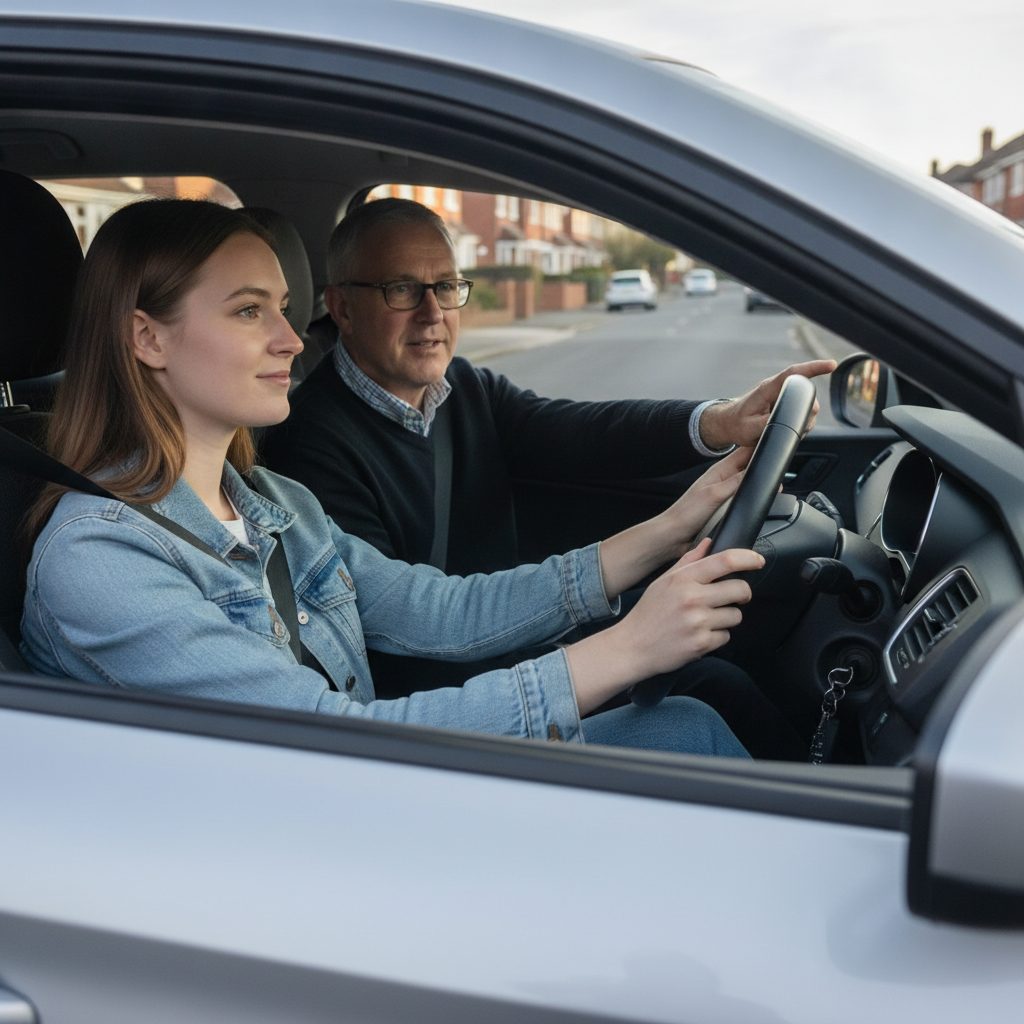
The Part 3 test evaluates your teaching competence. A DVSA examiner sits in the back of your car while you deliver a real 45-minute lesson to an actual pupil, who can be a learner or a full licence holder. The examiner grades your performance across three main areas: lesson planning, risk management, and teaching and learning strategies. You receive a score out of 51. Scoring 31 to 42 earns a Grade B, while 43 to 51 earns a Grade A. Anything below 31 is a fail. Like Part 2, you are restricted to a maximum of three attempts.
Trainee Licence vs Direct ADI Qualification
Once you pass Part 2 and complete at least 40 hours of practical Part 3 training with a qualified instructor trainer, you can choose between two routes to finish your qualification:
- The Trainee Licence (Pink Badge): This allows you to teach for reward for six months. It gives you practical experience with real paying pupils before taking the Part 3 exam. You must complete extra supervision hours and work under the sponsorship of an established driving school.
- The Direct Route (Green Badge): You continue private practice with a volunteer or friend until you pass Part 3 directly. You cannot charge pupils money until your full ADI registration is active, but you avoid franchise commitments and trainee licence fees.
Instructors planning to launch an independent driving school often use the trainee licence to build initial cash flow, transitioning to their own brand as soon as they receive their green badge.
Independent vs Franchise Business Model
Qualifying instructors face an immediate operational choice: pay a weekly fee to a national driving school franchise, or set up as a fully independent sole trader or limited company from day one.
| Feature | Independent Driving School | National Franchise |
|---|---|---|
| Weekly Franchise Fee | £0 | £70 to £300 per week |
| Lesson Price Freedom | Complete control | Set or heavily capped by head office |
| Vehicle Selection | Any suitable dual-control car | Strict model, age, and livery rules |
| Marketing Responsibility | You generate 100% of your pupils | Central bookings and national branding |
| Working Hours | Unrestricted flexibility | Often subject to minimum contract targets |
While a franchise offers an immediate supply of learner enquiries, the ongoing weekly charge eats into your profit margins. Independent instructors retain every pound they bill. You can find examples of successful local businesses operating across regions like driving schools in Hull and instructors in Bath who manage their own student rosters without paying middleman fees.
Dual Control Cars and Commercial Insurance
Your vehicle is your primary business asset. Independent instructors can buy a car outright, enter a hire purchase agreement, or use specialised ADI contract hire. Dual controls (such as He-Man cable systems) must be fitted by an approved installer. These link the passenger footwell to the vehicle clutch and footbrake, allowing you to intervene safely during lessons.
Standard personal car insurance is invalid for paid tuition. You must secure specialist driving tuition insurance covering:
- Hire and reward for driving instruction
- Any driver cover for pupils under instruction and driving examiners on test
- Public liability cover of at least £5 million to £10 million
- Dual-control replacement vehicle provision in the event of an accident
Selecting a reliable car with good all-round visibility, low running costs, and hard-wearing interior fabrics will minimise mechanical downtime throughout the working year.
Startup Costs and Setting Lesson Rates
Launching an independent tuition business requires working capital. Training and DVSA test fees generally total £1,500 to £3,500 depending on your provider. Fitting dual controls costs £300 to £600. Specialised annual tuition insurance ranges from £1,000 to £2,500 depending on your location and no-claims history.
Hourly lesson rates across the UK vary by region, commonly ranging between £34 to £45 per hour for manual tuition and £36 to £48 per hour for automatic tuition. When calculating your pricing structure, account for fuel usage, tyre replacements, vehicle depreciation, income tax, and National Insurance contributions. Tracking operational figures using platforms like rwapp.co keeps lesson diaries, bookkeeping, and earnings transparent.
Attracting Pupils in Your Local Area
Without a national franchise brand behind you, generating student bookings relies on local marketing channels. Most independent instructors build waiting lists using three core strategies:
First, create a clean Google Business Profile targeting specific postcodes. Ask pupils to leave genuine reviews immediately after passing their practical test. Regional demand in competitive areas like driving schools in Bury is heavily influenced by verified local review scores.
Second, place clear magnetic or semi-permanent livery on your tuition car with your phone number and web address. School car parks, college drop-off zones, and residential test routes provide daily passive advertising.
Third, build direct referral relationships with local sixth forms and colleges. Providing consistent, high-standard tuition leads to sibling referrals and word-of-mouth recommendations, ensuring your lesson diary stays fully booked throughout the year.
Run your whole driving school from your phone.
Get early access